I feel there’s an unspoken rule about Madoka– we don’t talk about Rebellion Story. But, rewatching it recently, I want to talk about a theory I have.
In the end, Homura pulls Madoka from godhood and rewrites the world to be the way she wants it to be.
Except… does she?
There are hints throughout the ending to suggest otherwise, but the biggest tip off for me came in the post-credits scene:

The sky isn’t real. The moon should block out the stars on its dark side, and the clouds should be in front of it, not behind it. We get a lot of shots of the false moon in this sequence. Why? To alert us that something’s off. This isn’t the real world.
Homura knows this. In her brief confrontation with Sayaka, she delivers this line:
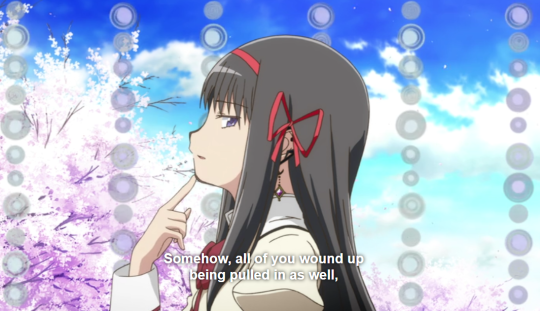
It’s the same language used for witches’ labyrinths, and for the world created in the isolation field. Homura did not care to rewrite the universe, she merely wanted a world where she can have Madoka, and Madoka can be “happy” as a normal girl. And her desire is so singular that that world does not have to be the real world. It only needs to be the real Madoka.
The intensity of focus is something the series has suggested for witches– the worlds they create are usually focused on their wishes– Sayaka’s is very music based, Charlotte/Nagisa’s has much to do with cake. Witches, it seems, are consumed by what they most desired, the root of their despair. Homura, of course, wished to save Madoka, and so when she becomes a witch, she can only care about having Madoka.
But she is more than a witch. Her soul gem never becomes a grief seed. The Incubator’s experiments put her in an interesting position:
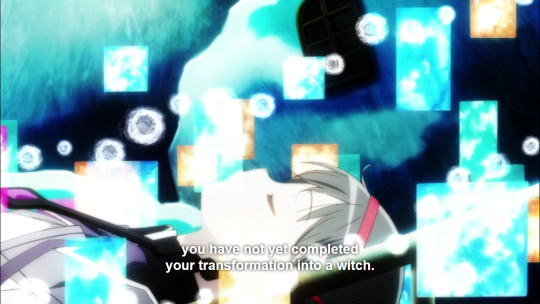

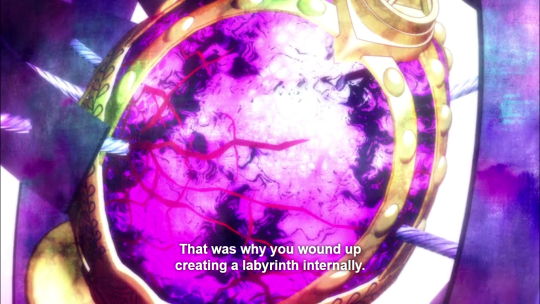
While in the isolation field, she is essentially in limbo. Her soul gem cannot break, she retains more of her full self than I believe witches normally do. She can feel joy, she can make choices beyond her own desires. Which is why she is able to choose to sacrifice herself to let Madoka become her true self once again.
However, once the isolation field is broken, she is no longer contained. When Madoka comes to her, Homura begins her true witch transformation, her soul gem bursting forth with energy:

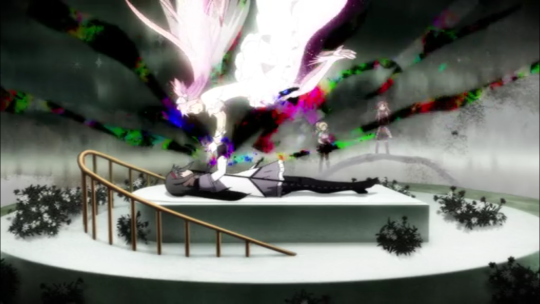
She shouldn’t be able to become a witch because of Madoka’s wish, and yet her soul gem has been pushed so far beyond its limits that she must become a witch. And because it was her wish that eventually led to Madoka becoming the law of the cycle, this allows Homura to break her, undoing the good Homura’s wish caused.

However, Homura should not have the power to undo Madoka’s wish– and later, we see she was not fully successful, as Madoka is still connected to her full self, even with Homura suppressing her memories. What, then, allows Homura to become something even more extreme than a witch?
When she breaks Madoka from the Law of the Cycle, she absorbs that power (symbolized by the pink thread) into her soul gem as it finally, fully breaks.


It is Madoka’s power that keeps the soul gem from becoming a grief seed. It becomes something new, and so does Homura:
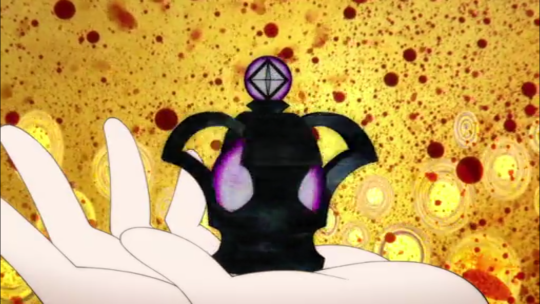

She calls herself a demon, to contrast Madoka’s godhood, the way witches contrast magical girls. And as witches are born from magical girls, so too was she born from Madoka’s power.
Kyuubey gives a lot of commentary here, at least some of which I believe is purposeful misdirection. He claims Homura is rewriting the laws of the universe, which is true– by containing the Law of the Cycle, she has brought a new world order. However, he also says it’s clearly too dangerous to work with humans anymore, which happens to be what Homura would most want to hear. She believes she’s in control now.

But that doesn’t hold up to what we know about the incubators. They do not understand irrationality, but neither do they fear it. They are determined to understand and manipulate everything to fight off entropy. And what has been their goal throughout the movie?


While Homura has Madoka captive, the incubators have exactly what they want. Magical Girls can once again become witches. The Law of the Cycle cannot reach them. By manipulating Homaru into believing she has finally beat them, they insure that she will continue to fight to keep Madoka in her labyrinth.
The post-credits scene shows Homura dancing over their tattered body, but there are several things to note that suggest that she is not victorious over them. We’ve never seen Kyuubey remain tattered, even when he’s stuck in a labyrinth. He went through the entire fight with Homura without ruffling his fur. Furthermore, there’s the imagery of the chair.

We’ve seen it before to suggest unreality:

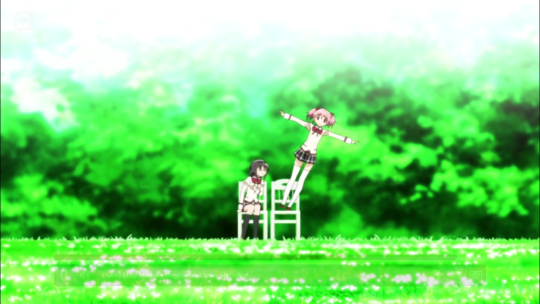
And like Madoka, Homura exits the scene with a fall.

Just like her grasp on Madoka was not real in the isolation world, neither is her triumph over Kyuubey. The film ends on him, zooming in on his eye before telling us it is the end:

Interestingly, his eye is fuzzy– a contrast to the unwavering stare he is otherwise always depicted with. This Kyuubey may not even be real, a mere illusion that is part of Homura’s perfect labyrinth world.
The real incubators, though? They have triumphed. Homura is trapped in her own labyrinth, and so is Madoka. They have free reign to collect energy in whatever way they find most efficient.






 SittingOverHereDreaming